
Mount Vernon Criminal History Checks
Begin a Mount Vernon criminal record search by naming the event and its likely custodian. The city police channel holds reports made by Mount Vernon officers. Municipal Court handles city ordinance, traffic, and other fine-only cases. The Franklin County jail documents county booking and custody, while the County Clerk and District Clerk hold filed misdemeanor and felony matters. The Texas Department of Public Safety adds a statewide layer based on data reported by criminal justice agencies, but it is not a substitute for the city report or full court file.
Use this order to keep one missing result from ending the search too soon:
- Ask Mount Vernon Police Department whether it created the incident or arrest report, using the report number when known.
- Send a precise city records request that gives the date, time, location, incident type, and exact record component.
- Contact Mount Vernon Municipal Court for a citation, fine-only state-law case, ordinance matter, or failure-to-appear process.
- Confirm any booking with the Franklin County Sheriff and then check the proper county clerk after a charge is filed.
- Use the DPS conviction name search for the public statewide reported layer, or fingerprint personal review for your own record.
A docket date, booking entry, police narrative, and DPS result can all concern the same event without containing the same facts. Keep the source and search date with each copy.
Mount Vernon Police or Sheriff Record
City limits and the arresting agency decide where a report begins. A Mount Vernon officer's narrative belongs with the city. A sheriff deputy's report belongs with the Franklin County Sheriff, even when the event occurred near Mount Vernon. The jail may hold intake data for both, but it does not become the custodian of the officer's incident narrative just because it booked the person.
The official Mount Vernon police page shows the city's police channel and was captured for the local record path.
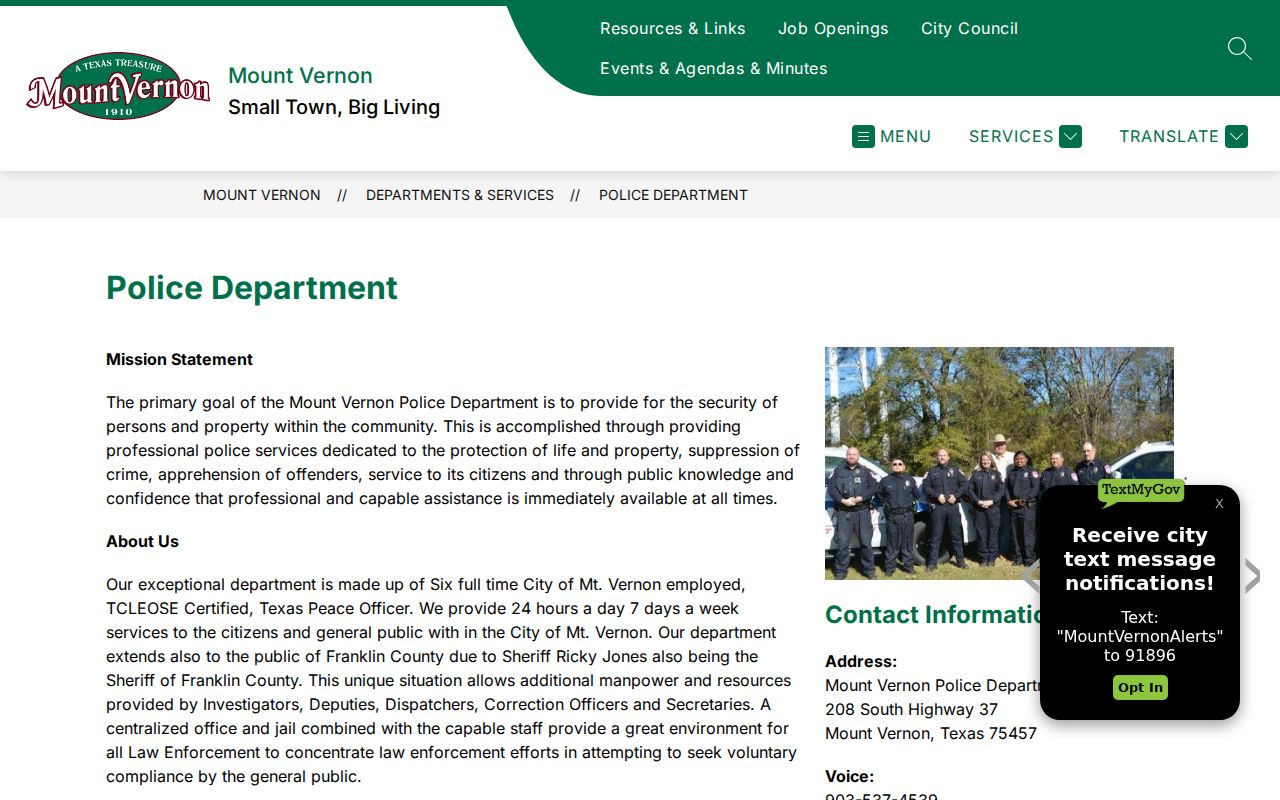
Use the page as an agency contact point, not as a case-name database. The published police number is 903-537-4539, which is also the Franklin County Sheriff number. Ricky Jones is listed as police chief and county sheriff. Those shared details are observed facts, but no reviewed source established that every record is under one custodian. Ask staff to confirm whether the city or county holds the exact report before sending the request.
Note: A shared phone number does not merge a Mount Vernon police report with a Franklin County sheriff report.
Records at Mount Vernon Police Department
Mount Vernon Police Department creates the first local record when its officer responds, investigates, or makes an arrest. A useful request identifies the report or incident number, date and approximate time, location, type of event, involved party needed to locate the file, and the precise component sought. State whether an electronic copy or inspection will meet the need and ask for an estimate before chargeable work. The city research did not establish a fixed police-report fee or a public case portal, so neither should be assumed.
City Hall at 109 N. Kaufman, Mount Vernon, TX 75457, routes local administration requests. Its number is 903-537-2252, fax is 903-537-2634, and email is cityhall@comvtx.com. Administration hours are Monday through Thursday, 7:30 a.m. to 5 p.m., and Friday, 8 a.m. to noon. The administration page links a Record Request Form and gives P.O. Box 597 as a mail route. Since the reviewed source did not yield every PDF field, write the request from known facts instead of guessing at required entries.
The official Mount Vernon city site provides City Hall imagery and department navigation used to reach those local offices.
The city site is the right place to verify current contact details before delivery. It does not turn the city information app into a criminal-history portal. That app advertises events, live-feed updates, notifications, and a staff directory, but not inmate, warrant, case, or report-copy searches.
Request Mount Vernon Incident Records Precisely
A broad request for "everything" about a name can slow a Mount Vernon search because several offices may hold distinct records. Ask the police custodian for a named existing record, such as the offense report, arrest report, dispatch or CAD entry, 911 audio, or a specified body-camera recording. Date, time, place, and the officer or report number help staff locate the material. Body-camera requests need especially clear event details, and protected victim, juvenile, medical, or active-investigation information may be withheld or redacted under Texas law.
An incident report tells what the officer documented. A booking entry shows intake. A court file shows what a prosecutor filed and how the judge resolved it. Requesting all three makes sense only when each answers a real question. If the search is for a crash investigated by another agency, ask whether the report moved to the Texas crash-record system. Mount Vernon staff should not be asked to create a custom list or conduct legal research.
- Incident report
- The agency narrative and event details created by the responding or investigating officer.
- Booking record
- The jail intake, charge, bond, custody, and release or transfer data created after arrest.
- Court file
- The complaint, charging paper, settings, plea, judgment, sentence, and other filed case material.
- Disposition
- The recorded result of a charge, such as dismissal, acquittal, conviction, or deferred adjudication.
Booking and Arrest Records in Mount Vernon
No city holding facility or public Mount Vernon arrest blotter was found in the official sources reviewed. The available facts point toward Franklin County booking at the sheriff and jail, 208 Texas Highway 37, but that is an inference rather than a documented universal rule. Call 903-537-4539 and give the arrest date, agency, and name to confirm the place of intake. A recent arrest may appear at the jail before any County Court or District Court cause exists.
Mount Vernon arrest records can split into four files. Police hold the incident and probable-cause papers. The jail creates fingerprints, intake, bond, and custody data. A clerk opens a cause after prosecutor action. DPS later assembles reported arrest and disposition data. The booking charge may change at filing, and an arrest never proves guilt. For a deeper county booking path, the Franklin County arrest search explains the jail and agency channels without treating a booking as a conviction.
Note: Record the time of a custody check because release, bond, transfer, and court status can change after the first search.
Trace Mount Vernon Arrest Records
When a Mount Vernon arrest moves beyond police custody, confirm the jail before searching for a judgment. The sheriff channel can establish whether Franklin County received the person, which agency made the arrest, the booking date, charge label, bond, and current custody status if those fields are public. Then wait for the prosecutor and clerk path. Class A and B misdemeanors generally go to the County Clerk at 200 N. Kaufman. Felony cases belong with the District Clerk at Annex West, 204 Texas Highway 37.
A transfer can explain why a person is no longer found in the county channel. After a state sentence and receipt into state custody, use the TDCJ locator. The Federal Bureau of Prisons inmate locator is a separate federal tool captured for this Mount Vernon page.
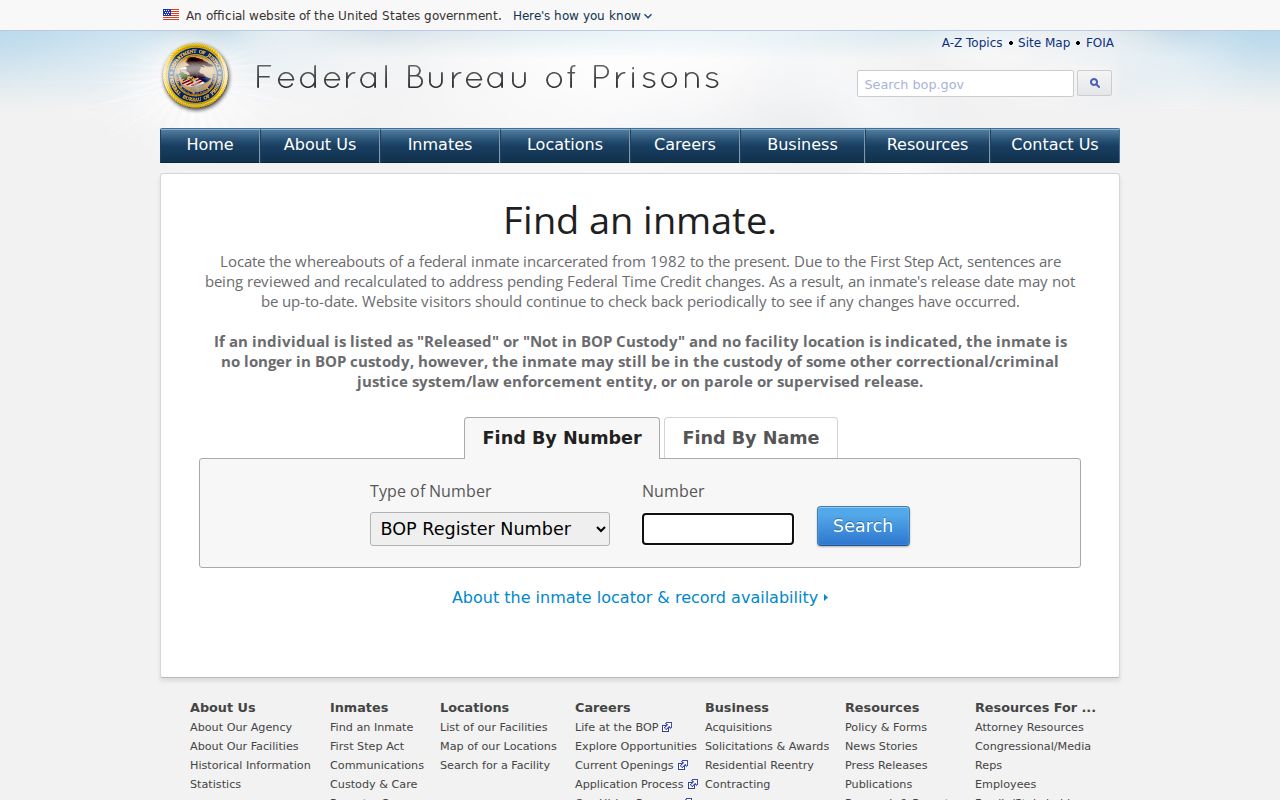
That federal locator does not search the Franklin County jail, a Mount Vernon citation, or a Texas state prisoner. Use it only when federal custody is genuinely part of the record trail. Matching the custody level prevents a false conclusion that no record exists.
The Mount Vernon Municipal Court File
Mount Vernon Municipal Court handles Class C and other fine-only matters, including traffic and city ordinance cases. It is at 109 N. Kaufman and uses P.O. Box 597, Mount Vernon, TX 75457. The number is 903-537-3582 and fax is 903-537-2634. The city identifies Christie Burnett as clerk. No public case-name search was found, so a person must use the clerk, counter, phone, or a written request rather than mistaking the card-payment vendor for a records database.
The official Mount Vernon Municipal Court page explains the court's jurisdiction and response channels.
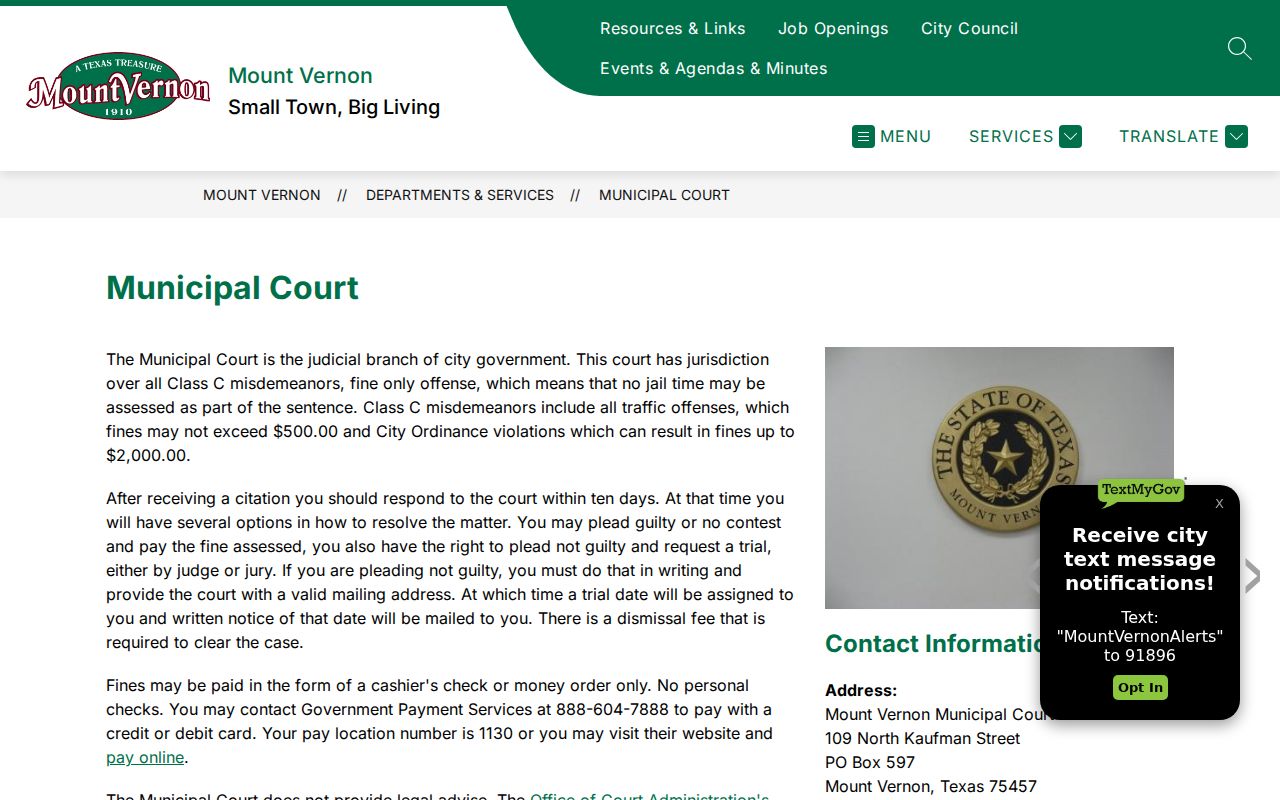
The court says a defendant generally responds within 10 to 14 days. A person may plead guilty or no contest and pay, or send a written not-guilty plea with a valid mailing address and request a judge or jury trial. Cashier's checks and money orders are accepted; personal checks are not. Cards route through Government Payment Services at 888-604-7888 with pay location 1130, but payment access does not show the full court file.
| Court Name | Mount Vernon Municipal Court |
|---|---|
| Case Types Heard | Traffic, ordinance, Class C, and other fine-only matters within municipal jurisdiction |
| Case Lookup Channel | Phone, clerk counter, or written request; no public case-name portal was found |
| File Contents | Citation, plea, notices, settings, payment or compliance entries, and judgment where filed |
| Copies and Fees | Confirm with the clerk; no city record-copy fee was established in the reviewed sources |
Missing Mount Vernon Citation Records
A Mount Vernon citation can be real even when it does not appear on a Franklin County misdemeanor or felony docket. Municipal Court has its own fine-only layer, including failure-to-appear processes. Start with the citation number, the defendant name and date of birth, and the date of the stop or notice. Ask the Municipal Court clerk to confirm the case, response deadline, plea status, settings, and any public judgment entry.
Move to the County Clerk only if the matter became a Class A or B misdemeanor filing. Use the District Clerk for a felony. A municipal payment page proves only that the vendor can take a payment tied to supplied details; it is not a public record lookup. If staff cannot locate the citation, confirm the issuing agency and court printed on the document. A justice court citation follows a different counter even if the event occurred near Mount Vernon.
How Mount Vernon Records Reach the County
A Mount Vernon record moves only as far as the event requires. Police create the city report. A custodial arrest may add a Franklin County booking. The County Attorney screens local misdemeanor charges, while a felony can proceed through the district prosecution and clerk path. The clerk or prosecutor reports qualifying disposition data to DPS. Fine-only Municipal Court matters may remain at city level and should not be assumed to appear in county felony or misdemeanor dockets.
Record flow: Mount Vernon PD › Franklin County Courts › Texas Department of Public Safety
The DPS Criminal History Conviction Name Search discloses public conviction and deferred-adjudication information reported to the state. It is not a certified Mount Vernon case file, and similar names can mislead. For one's own record, fingerprint-based personal review is the stronger identity check. The local police narrative and final clerk judgment remain the sources for the most detailed event and outcome facts.
Mount Vernon Criminal Record Counters
Several record offices cluster in Mount Vernon, yet they are not one counter. City Hall and Municipal Court are at 109 N. Kaufman. The historic Franklin County Courthouse at 200 N. Kaufman houses the County Clerk path for Class A and B misdemeanor files. Felony records are handled at Annex West, 204 Texas Highway 37. The sheriff and jail are at 208 Texas Highway 37. Calling the exact office first can save a trip to the right system but wrong building.
The county publishes dated district and county docket files, which are calendars rather than full outcomes. For a federal prosecution, the U.S. District Court for the Eastern District of Texas is the relevant federal court source captured here.
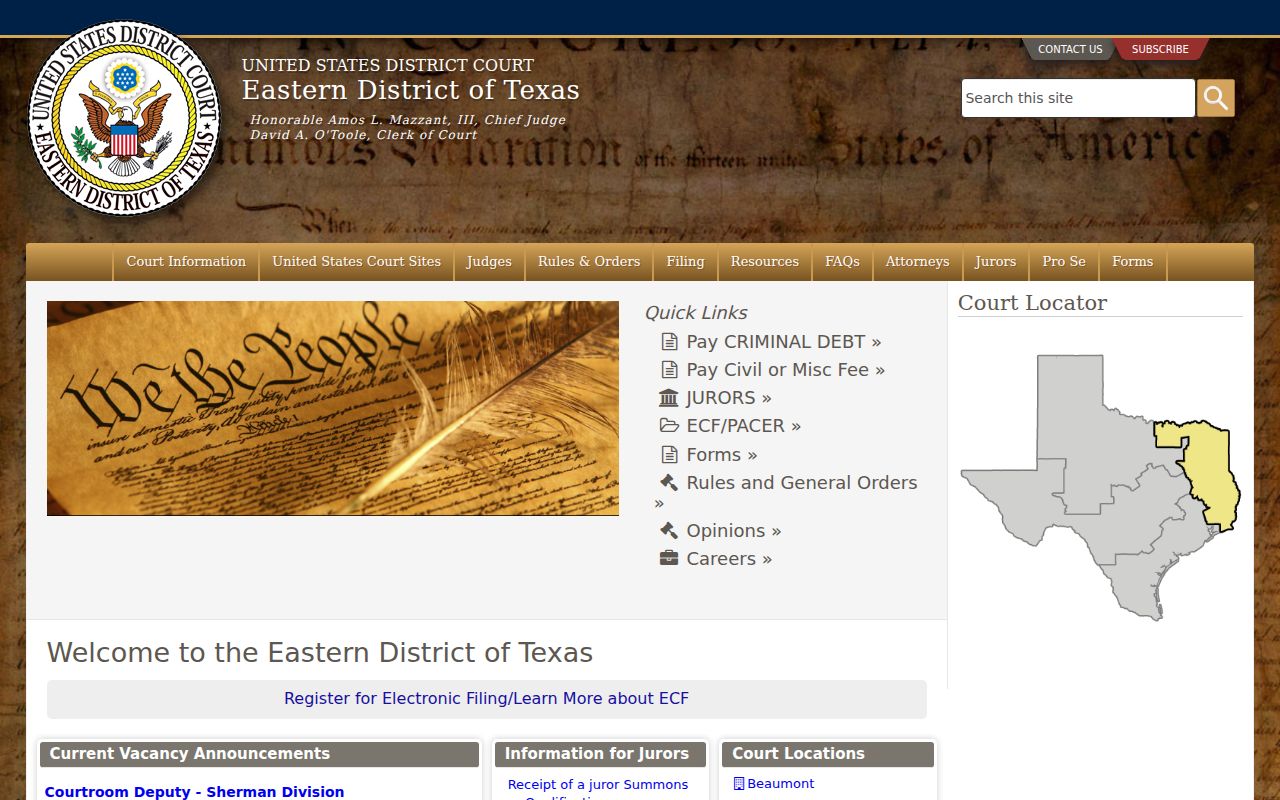
Federal court records do not belong to Mount Vernon Municipal Court or either Franklin County clerk merely because the person lives in the city. PACER is the federal docket channel, while the Eastern District site supplies court information. Keep federal and local searches separate.
Mount Vernon State Record Search
The Texas Criminal History Conviction Name Search can add reported statewide conviction and deferred-adjudication information to a Mount Vernon check. DPS currently charges one search credit per search, including a no-match. A name result should be compared with court identifiers because spelling, similar names, reporting delay, and an unmatched arrest-disposition cycle can create gaps or confusion.
For self-review, DPS directs the subject to the FAST fingerprint route and its error-resolution process. Use the city report to understand the event, the proper court judgment to establish the outcome, and DPS to see what reached the state repository. Those sources can disagree without any one of them being fabricated; each was made at a different stage and for a different purpose.
Note: A public DPS no-match does not prove that Mount Vernon police, Municipal Court, or a county clerk holds no record.
Mount Vernon Record Access Rules
The Texas Public Information Act applies to existing city police and administrative records, subject to exceptions. It does not force Mount Vernon staff to create a new list, answer legal questions, or release confidential material. Municipal court records follow the court and clerk access framework. Juvenile material, protected victim facts, active investigative information, expunction orders, and nondisclosure rules can limit what appears in a public copy. Ask for segregable public portions and a written basis when information is withheld.
Key Statutes:
Texas Government Code Chapter 552 governs requests for existing public information, costs, exceptions, and the Attorney General review path.
Texas Government Code Chapter 411 controls criminal-history dissemination and orders of nondisclosure.
Texas Code of Criminal Procedure Chapter 55A sets the current expunction process for qualifying records.
Government Code Section 552.301 generally gives a governmental body ten business days to seek an Attorney General decision when it wishes to withhold information and lacks a prior determination. That is not a ten-day production promise. Clarification, cost estimates, notice, and legal review can extend the practical response. A narrow Mount Vernon request is easier to route and review than an open-ended demand.